Picture the scene. A Series A founder hires a sharp marketing manager. The manager surveys the landscape, subscribes to six AI tools, and in ninety days triples the content output. Blog posts. LinkedIn threads. Email sequences. All generated faster than the company has ever moved.
The pipeline doesn't move.
The founder calls it an AI problem. It isn't. It's a sequencing problem, and it's the most common mistake I see early-stage teams make when they pick up these tools.
The number that should make you pause
72% of B2B marketers are now using generative AI tools. Only 41% can confidently point to improved ROI from those efforts. That's a majority of teams spending time and money on something they can't show is working.
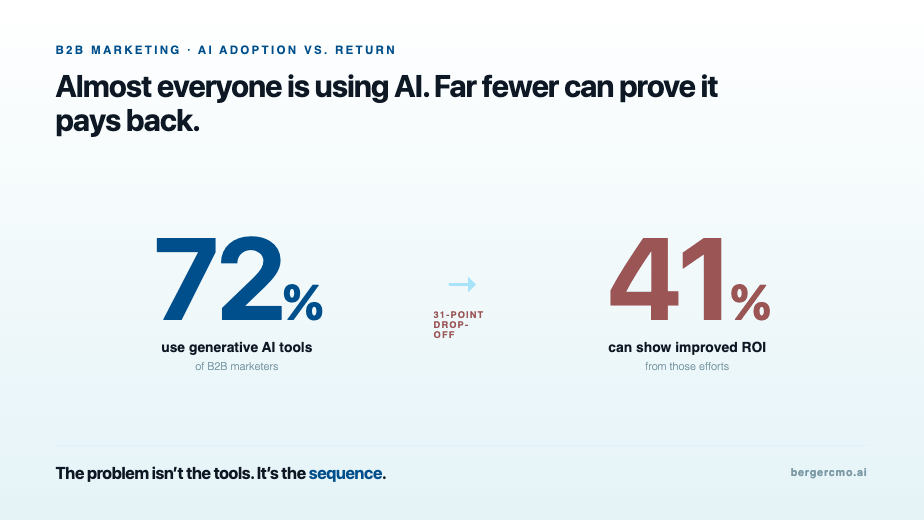
The instinct is to blame the tools. The tools are fine. The order is wrong.
What AI actually does to your marketing
AI doesn't create marketing that works. It amplifies marketing that already works.
This isn't a soft observation. It's structural. An AI content tool has no way to know your ICP beyond what you give it. It doesn't know which pain points your best customers actually feel versus the ones they say they feel in a first call. It doesn't know whether the message closing deals in a 30-person sales conversation maps to what should be leading your homepage. It works with what you hand it. Hand it something fuzzy and you get fuzz, faster.
AI doesn't fix weak positioning. It scales it.
I watched this play out with a Series A HR tech company last year. Their marketing manager, genuinely talented, built a content calendar around high-engagement topics. Trending news. Practical how-to posts. LinkedIn content that got shared. The numbers were good. The sales team stopped reading anything marketing produced. When I asked a rep why, the answer was immediate: "None of it sounds like what we actually sell."
They paused the AI tools entirely. Spent three weeks going back through closed-won deals, pulling the exact language customers used to describe the problem before they bought. Rebuilt the positioning brief from those conversations. Relaunched the content engine with that brief as the input for every prompt. Within 60 days, the sales team was forwarding articles to prospects mid-cycle. Same tools. Different inputs. Completely different result.
The AI did its job the whole time. The job was wrong, then right.
How to know if you have the foundation
Before opening a single AI tool, answer these three questions. If you can't answer all of them in under two minutes, you don't have the foundation yet.
- Can you name the specific job title, company type, and trigger event that describes your best-fit buyer, the one who closes fastest, expands most, and refers others? Not a category. A person.
- Can you write down, right now, the two or three things your best sales reps say in the first five minutes of a call that make a buyer lean forward? Not your homepage copy. What's actually working in the room.
- Do you know which one or two channels are generating real pipeline signal, and can you tell that story with data, not instinct?
What the right sequence looks like
The teams actually seeing pipeline impact from AI aren't the ones who adopted the most tools. They're the ones who were disciplined about what they fed in.
First: Document what's already working. Which messages, channels, and use cases are moving pipeline right now. Even if the signal is thin, whatever you have is the thing worth amplifying.
Second: Build the brief. ICP. Positioning. Competitive distinction. The objections buyers raise in late-stage conversations. This goes into every AI prompt. This is what separates the team producing five articles a month that get forwarded from the team producing twenty that disappear.
Third: Use AI to scale what's already resonating. More of the right message to the right person. Faster testing of variations on a headline that's working. Personalization on top of a framework that converts. Not experimentation on a foundation that hasn't been built.
McKinsey's 2025 research on AI in marketing workflows put it plainly: capturing value depends on "workflow redesign, data, and change management, not just tools." The tools are the last thing that matters.
The harder question
The tools themselves are the easy part. They're fast, cheap, and get better every quarter. Any marketing manager can set them up in an afternoon.
The hard part is building the inputs that make them useful: knowing who you're talking to, what moves them, which channel is worth feeding. That work is slower and less satisfying than launching a content calendar. It also determines whether any of this pays back.
74% of companies struggle to extract value from AI marketing tools. Not because the tools don't work. Because they're running on weak positioning and a vague ICP, and AI makes both worse at scale.
The uncomfortable question: If you started using AI tools today, what would you feed them? If the honest answer is "our current messaging" and you're not sure that messaging is working, that's the thing to fix first.
The AI advantage is real. But it belongs to teams who get the sequence right: foundation first, tools second.
You can skip that step. Plenty of founders do. They buy the stack, scale the output, and spend two quarters wondering why pipeline isn't responding. Or you can build the inputs first and give the tools something real to work with.
That's the choice. The tools don't care which one you make. Your pipeline will. See how a Marketing Audit builds that foundation in four weeks →