The founder had been running marketing himself for fourteen months. Sales calls in the morning, LinkedIn posts in the afternoon, homepage rewrites on Sunday nights. He was good enough at it to get to $1.4M ARR. He was also exhausted, and his board had been on him for two quarters to "get marketing off his plate."
So he hired a demand gen manager. Strong resume. SaaS background. Reputation for building pipeline.
Eight months later, pipeline was flat and the hire was gone. Not because she was wrong. Because the job she was hired to do couldn't be done yet. There was no clear ICP to target. No positioning brief to build campaigns from. No agreed message that sales and marketing both believed. She'd been handed a machine with no fuel and told to make it go faster.
This is the most common first marketing hire mistake I see at Series A, and it's a different mistake from hiring a full-time CMO too early. That one is about whether to hire a senior executive at all. This one assumes you've already made the right call there and are now hiring the person underneath. The decision between hiring in-house vs. a portfolio CMO is worth working through before you write the job description. And it almost never gets diagnosed correctly.
Most founders post a demand generation role for their first marketing hire because they want pipeline fast. That's usually the wrong call. Demand gen execution requires a positioning brief, a validated ICP, and channel signal to work from. If none of that exists, the hire has nothing to build campaigns from. The right first hire is a product marketer or T-shaped generalist who can work through positioning, run early channel experiments, and get close to sales, building the foundation that makes every subsequent hire more effective. The cost of getting this wrong, including recruiter fees, equity, and lost market time, routinely exceeds $200,000. In practice, the mismatched first marketing hire at a venture-backed startup rarely survives a year.
The job description founders write versus the job that actually exists
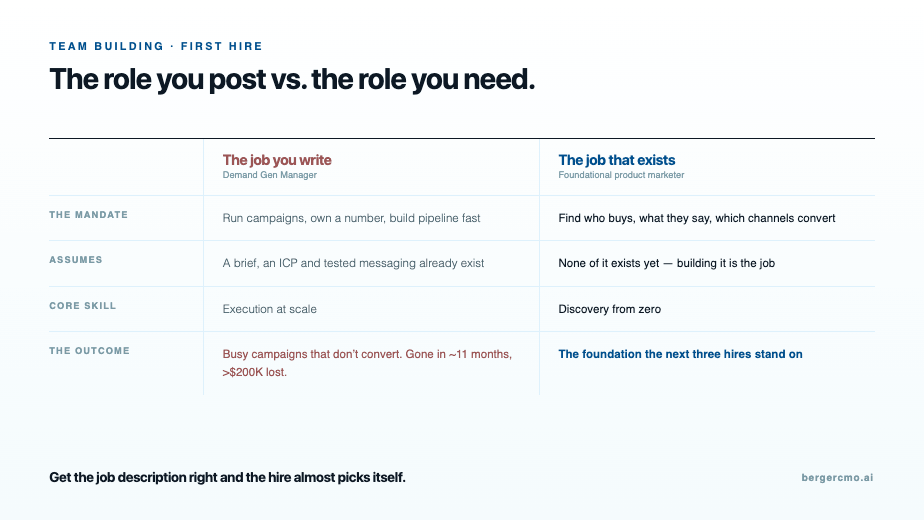
When a Series A founder decides it's time to make the first marketing hire, the instinct is to hire for output. Someone who can run campaigns, build pipeline, own a number. It sounds right. The board wants pipeline. Sales wants leads. The most legible thing marketing can do is produce both.
But here's what that skips: before any campaign can work, someone has to know who it's talking to, what it's saying, and why that message is true for this company and not three competitors. That's not campaign work. That's positioning work. Most Series A companies haven't done it yet.
A demand gen hire lands in a company without that foundation and runs into a wall immediately. They need a brief to build campaigns from. They need an ICP to target. They need messaging that sales has validated in real calls. If none of that exists, they either build it themselves (which isn't what they were hired for and isn't their core skill) or they make do with what they have. Which produces campaigns that look busy and don't convert.
In practice, the mismatched first marketing hire at a venture-backed startup rarely survives a year. The true cost, including recruiter fees, equity, and lost market time, routinely exceeds $200,000. That's not a talent problem. It's a sequencing problem.
The profile that keeps failing (and why founders keep hiring it)
There's a specific archetype that founders hire and lose within a year. They come from a name-brand company: Google, Salesforce, a recognizable scale-up. Strong metrics and a polished resume. They know paid acquisition. They know marketing automation. They've managed agencies and run multi-channel campaigns.
They arrive at a Series A company and look for the infrastructure they're used to: data analysts to pull reports, a design team to support creative, a content function feeding the funnel. None of it exists. The founder hands them a HubSpot login and says "make it work."
These aren't bad hires. They're wrong-stage hires. They were built for execution at scale, not discovery from zero. Those are genuinely different skills. Most job descriptions don't distinguish between them because most founders have never had to think about it until they're eleven months in and the role isn't working.
Maya Spivak, who built early marketing at both Segment and Wealthfront, put it plainly: "For a first hire, I favor the T-shaped marketer or someone who has extensibility. So many things can change in the earliest stages of a product." She's describing someone who can operate without a playbook. Not someone who needs one handed to them.
What the job actually is at Series A
Here's the work that has to happen before any channel pays back:
Someone has to talk to fifteen closed-won customers and pull out the language they used to describe the problem before they bought. Not the language your product team uses. The language buyers use when they're still deciding. That language becomes the positioning brief. The brief becomes the ad copy, the email sequence, the homepage headline, the sales deck opening. Everything downstream depends on it.
Someone has to figure out which one or two channels have real signal and which ones just have activity. That means running small experiments, reading the data honestly, and killing things that feel good but don't convert. Harder than it sounds when the founder is emotionally attached to the blog or the LinkedIn presence they built themselves.
Someone has to get close enough to the sales team to know what objections surface in late-stage calls, which competitor keeps appearing, and which message makes a buyer lean forward versus go quiet. Marketing at Series A isn't a separate function from sales. It's the same conversation at a different stage of the cycle.
None of that work shows up well in a demand gen job description. It shows up in a product marketing description, or in a description written for someone who understands that building the foundation is the job, not executing on top of one that doesn't exist yet.
How to write the right job description
Before you post anything, answer these honestly:
Do you have a positioning brief your sales team uses in calls? Not a messaging document sitting in a folder. Something that shapes how reps open conversations. If the answer is no, your first hire needs to build it. That changes the profile entirely.
Do you know which one or two channels are generating real pipeline signal? If you're still guessing, your first hire needs to run discovery experiments before scaling anything. That's not a demand gen skillset.
Can a new hire understand your ICP clearly enough to brief a campaign in their first two weeks? If you can't hand someone a document that answers this, they'll spend their first three months figuring it out on your clock.
If the answer to any of those is no, the right first hire isn't a demand gen manager. It's someone who can work through positioning, run early channel experiments, and build the brief that makes everything else possible. That person is usually a product marketer, a generalist with real range, or someone who has done exactly this at a company one stage ahead of yours.
What to listen for in the interview: Ask candidates to describe a time they had to figure out what was working from scratch. No playbook, thin data, ambiguous brief. The wrong candidate describes optimizing campaigns that were already running. The right candidate describes how they found the signal before there was a campaign to optimize.
The sequence that actually works
I worked with a B2B fintech company at Series A that made this mistake and caught it early. They'd hired a strong demand gen manager six months in. She was good. But she kept asking for a brief that didn't exist, and every campaign she built was on messaging the CEO had written himself and never tested with buyers.
They paused. Brought in a product marketer for 90 days to do nothing but customer interviews, competitive research, and a positioning brief. The demand gen manager helped inform the research. When the brief was done, she picked up the campaigns and they started converting. Same person. Same channels. Different foundation.
The model that works at Series A: senior marketing strategy set by the founder or through a fractional CMO engagement, paired with one strong generalist who owns execution and can build before they scale. Not a specialist who needs a mature function to plug into. Someone who can figure out what works from scratch.
That person is harder to find than a demand gen manager with a polished LinkedIn profile. They don't optimize for visibility. They optimize for signal. At Series A, signal is the only thing worth chasing.
The first marketing hire doesn't fail because founders choose badly. It fails because founders write the wrong job description for where the company actually is. The role they post is the role they wish they needed. The role they need is the one that builds the foundation the next three hires will stand on.
Get the job description right and the hire almost picks itself. Get it wrong and you'll be writing it again in eleven months, a little wiser and considerably more expensive.
Write the description for where you are, not where you're going. Not sure what that description should say? That's where a Marketing Audit starts →